The James Jennings Project
Hitchhiking On A Narrow Road
Hitchhiking On A Narrow Road
Are you turned off by religion?
You’re not alone. Jesus was no fan either. In his seminal sermon, Jesus addresses life in the Kingdom of God. Jesus paints a picture that looks starkly different from how many perceive today’s American Church. Did Jesus call us to a life of enculturated religion or did he intend something different?
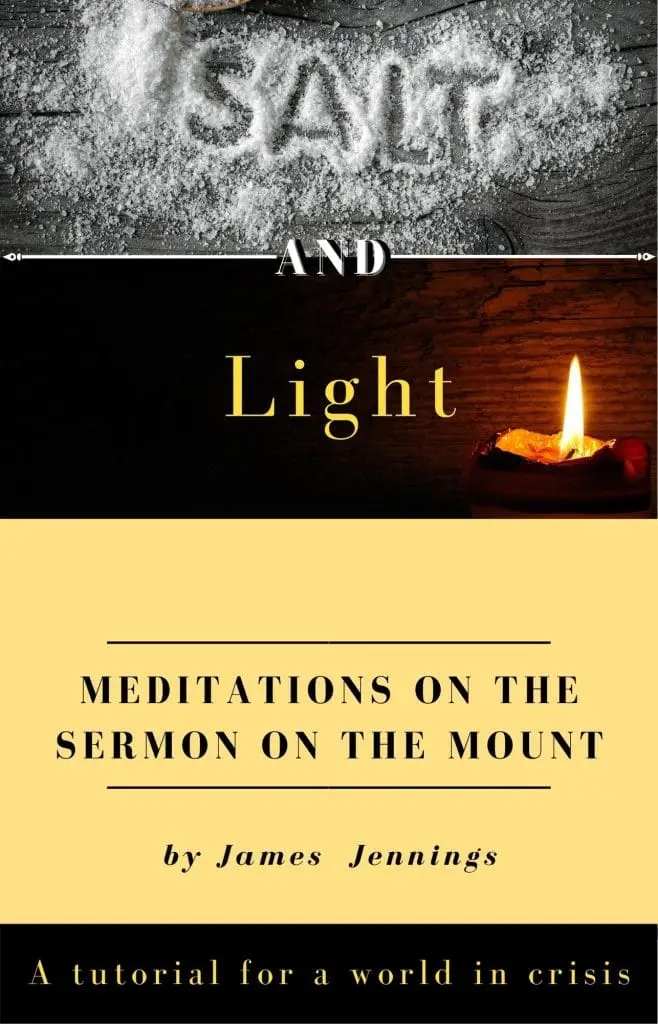
Salt and Light- Meditations on the Sermon on the Mount is a 43-day journey through Jesus’ best-known sermon. It provides an in-depth study of the Gospel of Matthew chapters five, six, and seven, with personal observations, applications, and devotional suggestions from the author. It explores how the entirety of scripture shines a light on Jesus’ words (and how Jesus’ life illuminates and challenges our understanding of scripture.) The book also explores how the culture, environment, and circumstances of Christ’s world reveal clues as to their meaning.
In this study, the author asks questions that are increasingly relevant for today’s American Church:
Jesus’ words provide hope for today’s troubled world. Additionally, they should leave us uncomfortable, whether we see ourselves as conservative, liberal, post-modern, or traditional.
This study is for anyone who wants to grasp what it really means to follow Jesus. You may be comfortable in your church, be questioning your faith, or be on a journey through deconstruction. Your experience with Church may seem like a betrayal of a faith you once loved and you may want to return to the basics of a simpler faith. Whatever your situation you are invited to sit with Jesus and reimagine what it means to thrive in the Kingdom of God.
“I begin with two hypotheses:
First, the core of what it means to be a follower of Jesus is expressed in the Sermon on the Mount. In my opinion, no other section of scripture expresses what Jesus wants from us as clearly as this sermon does. It is the foundation for following Jesus. It eclipses any creeds, man-made doctrine, or Church tradition. I believe it stands alone and above all other scripture… In short, if we want to think like Jesus and live like Jesus, the Sermon on the Mount should be written on our hearts.
Second, it’s our responsibility to understand what Jesus is saying. To grasp that, we have to study, pray, and search our souls. There are complex concepts and seemingly impossible challenges here. There are only two sources that speak to this, with authority. Only the totality of scripture can shine a light on the meaning of any single verse. This means you may need to grapple with verses that appear to contradict the others… The other source is God’s Spirit. God does not hand us a Bible and abandon us. If we carefully listen for His voice, He will open our hearts and minds. He will prompt us to ask questions and challenge our presuppositions. He will transform us if we allow Him to…
There is a contrast between religion and genuine faith in our current challenged and often disturbed world. Faith has always fostered lasting peace, compassion, mercy, and hope. In contrast, religion has often engendered ignorance, arrogance, tribalism, and selfishness. Faith moves us two steps forward, while religion pulls us two steps backward. Jesus emulated faith and opposed religion. If it doesn’t look like Jesus’ Sermon on the Mount, it’s not faith and is likely to do more harm than good…
Jesus promises that he will build his church and “the gates of Hades will not overcome it” — Matthew 16:18. That promise doesn’t mean that the Church won’t go through periods where it loses its way. It doesn’t mean that deception and idolatry will never threaten our mission. I believe that we are in the midst of a time like that.”
“I first read the Sermon on the Mount back in January 1974, and today, it still leaves me weak in the knees and hungry to hear more. Throughout this year, I have been living in those three chapters. Since 1974, I have called myself Christian and Evangelical. I’ve followed the crowds to small group studies and megachurches. I’ve listened to Christian Music and attended conferences and seminaries. I’ve led worship, shared my faith, and struggled to be more authentic. I suppose those things have their place, but when I place the total of their impact on my soul next to those chapters in the Book of Matthew, they seem unremarkable…
Can we spend some of this next six weeks, together, chewing on Jesus’ sermon? I want and need to get back to what I experienced back in 1974. There I first opened my Good News for Modern Man and read about Jesus. His words broke me and gave me new life. Jesus has, I believe, been a part of my journey since then, but it’s time to return to the basics. I’m convinced that Jesus’ most well-known sermon is the place to begin. I hope that what is written here encourages and challenges you to join with Jesus. If you’ve never met him, there is no one more important. If you used to love him but have forgotten, I hope this draws you back to your first love.”
“Let’s look, with honesty, at Jesus. There is something there to challenge, and possibly offend, the worldview of nearly everyone. Up to this point, we see a Jesus who appeals to a more liberal sense of the world. Blessing the poor, the humble, the persecuted, and affirming the value of all those who follow him. In this section, Jesus wades into seemingly more conservative waters. Here, he stresses the enduring importance of The Law. When I read this section, I am reminded that Jesus doesn’t consider holiness optional for his followers. It is essential. In Jesus’ vision of the kingdom, God doesn’t look the other way when we sin. He doesn’t grade on a curve. Those with a more liberal take on the world often major in God’s grace, patience, and forgiveness. They may stress the Jesus who tells the woman, caught in the act of adultery, that he does not condemn her, but then they ignore the second half, where he tells her, “Go now and leave your life of sin.” — John 8:11 (NIV)…
The Pharisees spent their lives cultivating an appearance of righteousness, but Jesus was no fan. Certainly, they followed the Law, at least externally and to the letter. Still, if the Law didn’t specifically prohibit some evil, they had little issue with it. Jesus expressed his disdain for that sort of faux-godliness…
I disagree with the commonly held view that the Law is no longer valid. Isn’t believing that to call Jesus a liar? Jesus did not come to invalidate the Law, but he came to better illuminate our path…
Again, the Pharisees missed the point of the Law. It’s not about following a bunch of irrelevant rules to gain respect from the community or gain currency with God, It’s entirely about loving God and neighbor. It’s about our heart and our intent.”
t
“… I see both extremes as equally harmful. As in most things, a middle ground is usually the most healthy and wise course. Neither Hugh Hefner nor a castrated Origen reflect God’s desire for us. I seriously doubt that Jesus’ imagery of plucking out an eye or cutting off a hand was offered as a serious response to temptation. I speculate that he was merely using a word picture to illustrate the supreme importance of our souls. For all who claim to interpret scripture literally, it seems few have followed in Origen’s footsteps, which is good. A genuinely literal interpretation of scripture would render a congregation of amputees and blind eunuchs…
God seems outraged by David’s involvement in war and the harm he did to Bathsheba and Uriah. He says virtually nothing about David’s sex life. Eight wives resulted in mostly silence. War seemed to be a more significant concern to God. Doesn’t much of the Church’s obsession with sex seem to have those concerns swapped? …
Desire is a healthy and natural part of life and can be good. It’s human to want a safe, comfortable, and healthy life. It’s right to ask God to give us the means to have our daily bread. God understands our need to be loved, to not be alone and our desire for a healthy sex life. Even desiring more than we have is perfectly fine. The problem is when that desire becomes an obsession. We get off track when what we want is more important to us than God or others, and we become willing to scrap everything else for the object of our desire. We run into problems when we are unwilling to accept that God might shut the door on that desire. It stops being healthy and becomes coveting. It becomes idolatry, and no idol can ever give us lasting peace or true joy.”
ontent
“I suspect that Jesus meant at least two things with this metaphor about light and the eye. He may have been telling us that we should love God and neighbor more than possessions. Additionally, we should have a single-minded focus on developing a worldview based on the kingdom of God instead of the kingdom of man…
If you’ve ever worked in a job where you had more than one supervisor, and they disagreed, you know that it is impossible to have more than one master. Jesus tells us that you can’t serve both God and money. The word translated money is Mamona or Mammon. Mamona was an Aramaic word that meant riches. It likely derives from the concept of something that one trusts. While Jesus was explicitly addressing money and treasures, Mammon can be any idol that we treasure…
Daily, we are confronted with the choice of following Jesus or something else. All too often, we choose a different master. We may demonstrate our spiritual weakness by being stingy. We may opt for judgment over grace. We may allow tribal propaganda to overwhelm our commitment to truth. Perhaps we permit our cultural, racial, political, or ideological worldview to corrupt Jesus’ image. Whenever we do this, we are following in Judas’ footsteps. This doesn’t damn us as evil, but we should be wary. When we serve a different master, the result is never good. Jesus will never be a cheerleader for our culture wars, ethnic identity, political, or economic class. We simply reveal our idols when we attempt to kidnap Jesus and conscript him into our ideological conflicts.”
“As we come to the end of Matthew chapter six, I want to stop and give us a moment to reflect and ask God to speak directly to us…
When we only see ourselves as righteous, what do we leave for Jesus to do in our lives? He comes to us only when we recognize our need for him and our frailty and propensity toward selfishness…
Like the Pharisees, far too many of today’s religious leaders not only fail to promote justice, display mercy, and embrace humility, they seemingly oppose those things. Like the Pharisees, they seem to despise justice. They embrace or fabricate half-truths and lies and promote political and social agendas which foster injustice. Instead of embracing mercy, they seemingly rejoice in the pain and hardship of those they see as sinners. Rather than loving the world that God “so loved,” they portray the entirety of those outside as either a threat to be opposed or a resource to be tapped. They often portray humility as weakness. They promote and raise leaders who never question themselves, much less ask the complex and soul-searching questions that genuine faith requires…
Jesus’s message to the Pharisees on that hillside rings true for the many who corrupt our faith today. His you have heard it said, but I tell you antitheses seem to be pointed at them- all those years ago and today. Just as the influential religious leaders, in Jesus’ day, had misinterpreted, misled, and harmed God’s message and attacked those who questioned, they often do much the same today. Few of the Pharisees had hearts soft enough to receive Jesus’ message. I pray that today’s wolves in sheep’s clothing will reject their traditions, take a step back, and listen to Jesus’ words…
Of greater significance is how few, in the wider Christian community, push back. It’s concerning that so few ask questions or point to how far we have strayed from Jesus’ commission to “go, and make disciples” — Matthew 28:19, 20. Consider the bracelet that many wore a few decades ago- What Would Jesus Do? How much of what characterizes the wider American Church today reflects Jesus? While none of us are perfect, where does the concept of genuine repentance fit into the life of the Church today? …
Today’s prayer:
Lord Jesus,
I have been told what it means to honor God and live in this world, but perhaps, some of that was incorrect. Others have offered examples of their belief of how a godly person should think and behave. I should indeed honor and respect those who have taught me, but only you have the words of life. Only you have authority in this. Help me put aside beliefs, thoughts, values, and loves that don’t reflect your nature. Even if it puts me at odds with those I love, set my feet on a path that follows you, where you direct my faith. Lead me to genuine and honest repentance, and change.”
“… In these verses, the verbs ask, seek, and knock are commands in the present imperative. This indicates that they are seen as continuous actions. In essence, Jesus is saying, ‘Keep asking. Keep seeking. Keep knocking’…
Suppose we were to commit the entire Old and New Testament to memory. If we fail to treat others the way we want to be treated or if we fail to love God and neighbor, then we have failed to live a kingdom life…
Jesus’ Golden Rule demands that we don’t simply avoid harming others but that we actively put ourselves in their shoes and promote justice for them…
Since verse twelve begins with ‘therefore,’ Jesus is giving a condition for receiving what we are asking, seeking, and knocking. If we don’t consider the needs of others, we shouldn’t expect God to answer our prayers for other things. When we are genuinely seeking God’s kingdom, we will actively be pursuing the common good of our neighbors. If we are blind to the suffering and injustice a neighbor is experiencing, our vision is on the worldly kingdom rather than the heavenly kingdom… “


“In a clear, easy-to-read style, James walks us through the Sermon on the Mount with practical insight into the heart of Jesus’ teachings and their real-life applications. The book is simple to understand, yet deeply challenging to those who desire to see past surface behaviors and delve into the heart of what it means to be a Christ-follower.“
Ron and Cyndi Hawthorne– (MI)
“Prepare to be challenged in your Christian thought and walk. This is not your usual evangelical fluff or lightweight, feel-good then throw away pamphlet, but a thought-provoking devotional with insightful and well-studied Bible exposition with a personal challenge to American cultural Christianity in our lives individually and corporately. Whether you come away from the book in full agreement with the author or not, you will be enriched spiritually by the careful study and the skilled writing. This book is a keeper!“
Amazon Customer
“I met James on Facebook and was always impressed with his insights on a wide variety of topics. When I found out that many of those insights were in book form, I knew I had to secure a copy! In reading his perceptive work on the greatest sermon ever delivered, numerous things became apparent. Aside from his solid exegesis, I was impressed with his honesty and balanced approach when dealing with divisive issues. James does not back down from critiquing those who lean right or left but refreshingly, there is no venom in his critique. While his book is devotional, James also gets into the Greek meaning of some words and phrases to help illuminate the meaning of a given text. I found this beneficial. In an age when some are embracing a more aggressive and militant view of the Christian faith, James calls us back to this challenging sermon, the heart and soul of Christian ethics. When many in the church are seeking to minimize the impact of the upside-down ethics of Jesus, James is calling us back to His profound and life-giving message.”
John Marino– (CO)
“Just as Mt Sinai was the revelation of the Hebrew covenant, James acknowledges the Sermon on the Mount as the revelation of the Christian covenant and seeks to call Christians back to the heart of their faith. James Jennings reminds us through this devotional that Jesus calls us once again to remember what made that revelation so ground-breaking. Never have we needed a reminder like this to return to the simple faith of Jesus Christ. James lays his heart bare as he talks about his own call to return to the simple words of Christ in a time like this. You can feel James’ heart touch Heaven as he struggles to recover the purity of his faith. Let this book challenge you to return to the source of true love as well.
As James discusses the promises available to the poor in spirit, those who mourn, the hungry, the pure in heart, peacemakers, and the persecuted, he reminds us that God is not on the side of those who have it all, but on the side of those who are in need. This book did a great job of bringing me back to the joy of my early days of faith. It reminded me how good it is to live with the awareness that God is big enough to overcome anything I might face.“
Dennis Gunnarson– (WA)
“In my recent time of a new view on my faith in Christ, I know more and more that todays modern version isnt a representation of Jesus and His purpose 2000 years ago. James’ book gives an in depth perspective on how different the view of Gods kingdom is compared to evangelical’s view of Gods kingdom. When I read each sentence, I see James takes time and reflects on Jesus true love and wants people to open their eyes and know there is good in Christianity, but it cant be mixed with American/Evangelical theology.“
Noah Aguilar– (CA)
“Five stars. James Jennings earns it with an unvarnished, juxtaposed yet friendly view of what could be. He openly provokes me and my “kingdom” to see what Christ meant (by what He said) and how He behaved. THAT kingdom is the one that endures, that has our collective best at heart. Having memorized the SOTM in middle school (church school), I appreciate Jennings’ affable tone that reminds me of the kind teacher who helped me recite it (in KJV). Still, this book is prickly, asking why I don’t subscribe entirely to the SOTM. Sitting on the fence eventually hurts the groin. And that’s the point–I won’t move until I’m uncomfortable.
Reader beware– you may need to choose. You will have to ponder. You may start inventorying your mores/theology. This sorting and cataloging is really important for people who have been around scripture for decades. Jennings’ book leaves little place for “DNI” (do not inventory).“
Wendell Au (HI)